
You have a name. You go to buy the domain, and the .com is either taken or costs several lakh rupees. Now what?
The advice you will find is confident and comes with no numbers. Launch on .in, buy the .com when you raise. A clean .in beats a messy .com. Indian buyers trust .com more. Almost all of it is anecdotal.
So we counted instead. This is the second half of a two-part study. The first part looked at how Indian D2C brands are named, using the same 1,500+ brands. This one looks at where they sell from.
For every brand we recorded the domain, then looked up the date that domain was first registered in the public registry records. We did the same for the matching .com, whether the brand owns it or not. Those dates matter. They let us answer the question everyone actually asks: can you start on one ending and move to the other later?
The short answer
- Both endings are normal. Six in ten of these brands sell from a
.com. A third sell from.inor.co.in. - The mix has not changed since 2009. Neither ending is rising or falling.
- Your brand name mostly decides what is available. Short names and everyday English words are usually gone already.
- Brands on
.inare more likely to have their exact name as their address. 89.3% of them do, against 79.8% of.combrands. - Almost nobody moves from
.into.comlater. Of 185 brands that sell from a.comand own the.inas well, only six registered the.infirst. - Twenty-four brands own their
.comand sell from a different ending anyway. Some bought the.comyears after launching and still did not move. - A
.inwill not hurt your Google ranking. Google has said country endings do slightly better for local searches, not worse.
We have no price data, so we cannot tell you what any of this costs.
Which domain endings do Indian D2C brands use?
Indian D2C brands use twenty-three different endings. Two of them account for almost every brand.
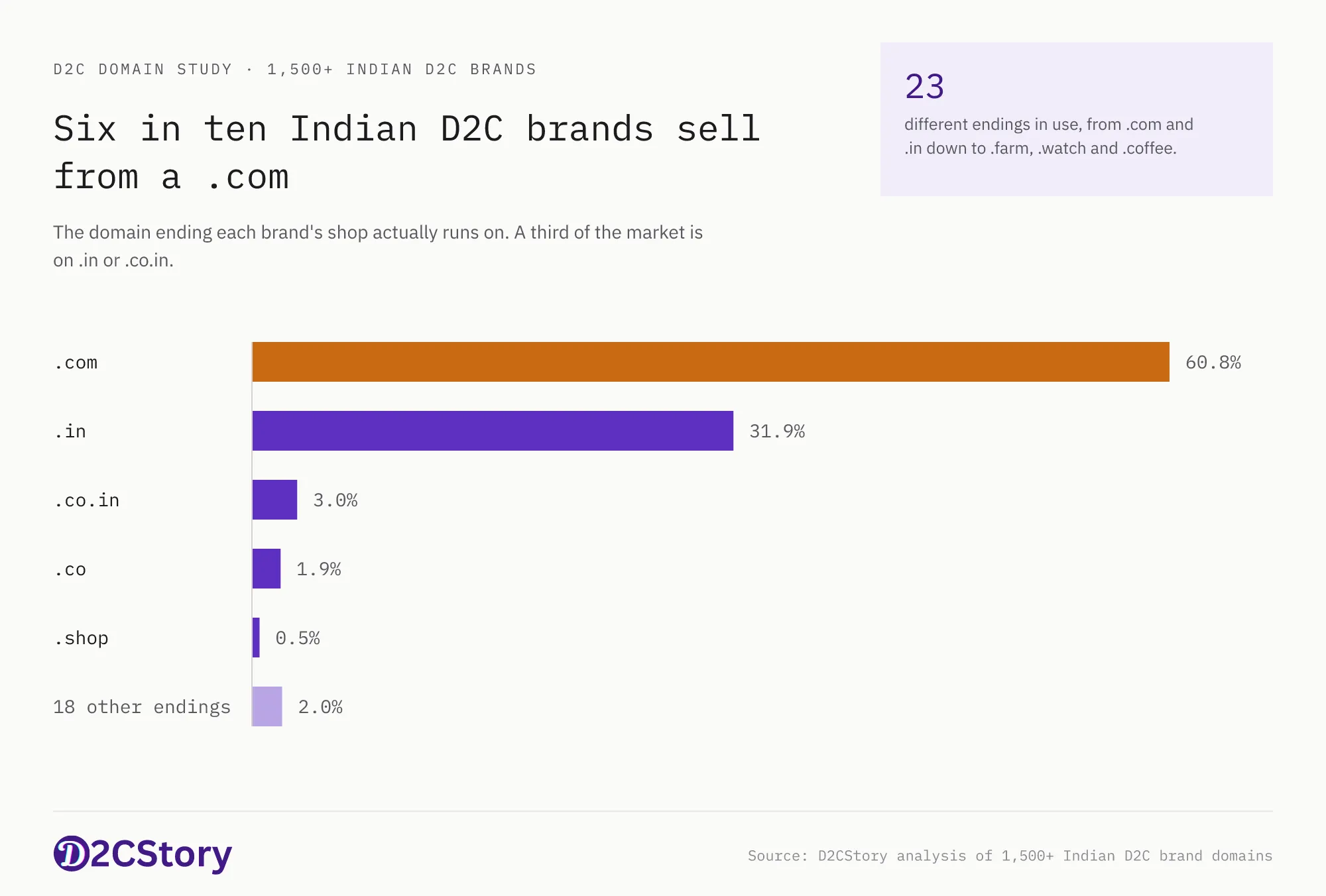
The rest are spread thin. Three brands each on .life, .online, .org and .health. Two each on .coffee, .net, .biz, .world and .fit. One each on .store, .company, .farm, .me, .watch, .io, .kitchen, .xyz and .ai.
Group them and you get 60.8% on .com, 34.8% on .in or .co.in, and 4.3% on something else.
Twenty-nine brands sell from .co. That ending gets left out of almost every guide on this subject, and we come back to it below.
If you are weighing .in against .co.in, we could not find a difference that matters. Brands on .co.in have their exact name as their address 89.1% of the time. Brands on .in, 89.3%. .co.in is simply the rarer of the two.
Has .in become more popular over the years?
No. We expected some movement, so we split the brands by the year each one was founded.
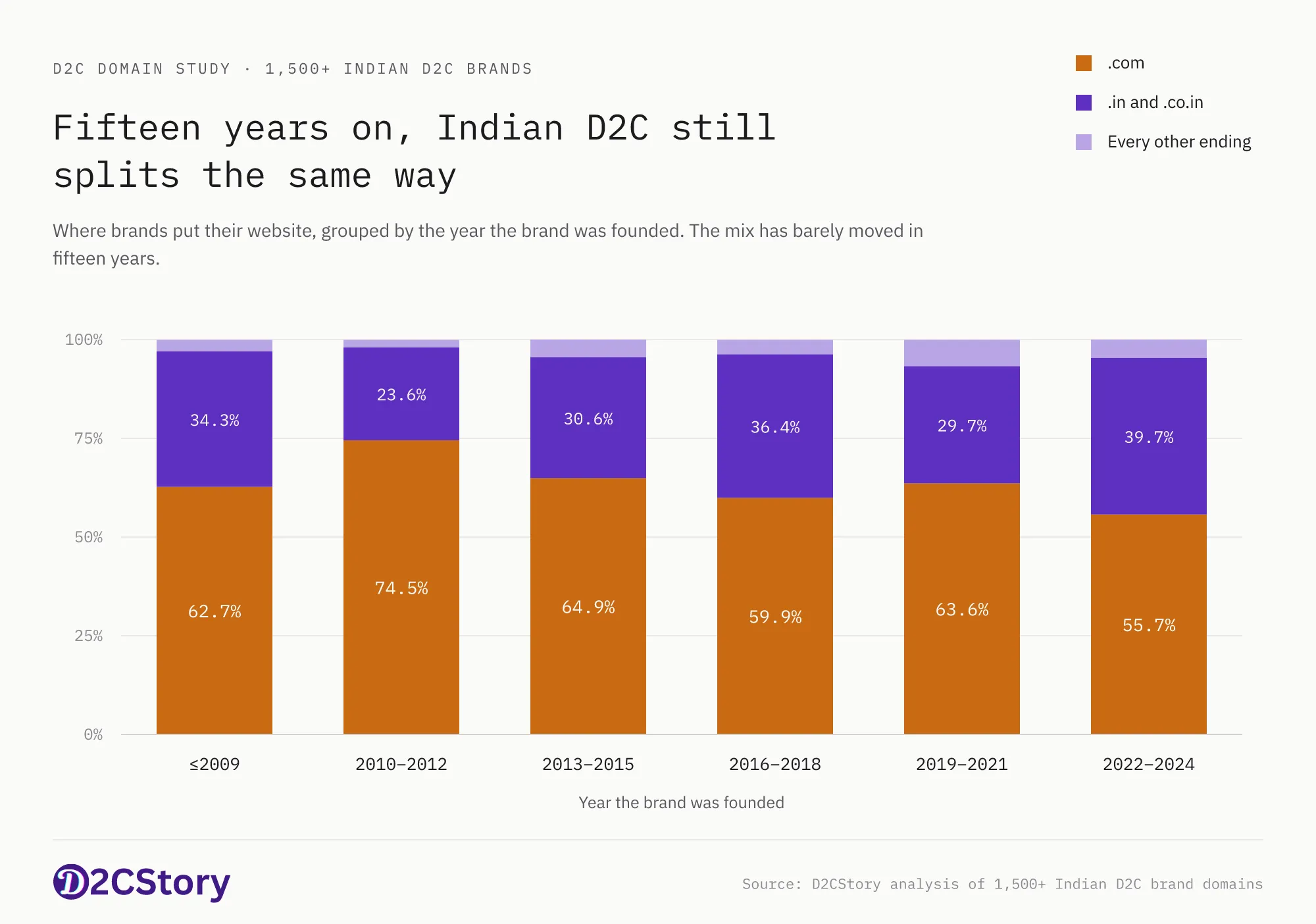
Brands founded in 2009 or earlier sell from a .com 62.7% of the time. Brands founded between 2022 and 2024 do so 55.7% of the time. That looks like a decline. With numbers this size, the gap is small enough to be chance.
One bar sits higher than the rest. That is 2010 to 2012, at 74.5%, and it is built from fewer brands than any other bar on the chart.
So the split today is roughly the split in 2011. Whichever ending you pick, plenty of brands have already picked it.
Does your brand name decide which domain you can get?
Mostly it does. Two things matter, and both are fixed once you choose the name.
The first is how long the name is.
| Name length | Brands | Sell from a .com |
|---|---|---|
| 5 characters or fewer | 150 | 47.3% |
| 6 to 7 | 279 | 55.6% |
| 8 to 9 | 344 | 59.0% |
| 10 to 12 | 425 | 64.7% |
| 13 to 15 | 230 | 68.3% |
| 16 or more | 125 | 67.2% |
With a five-letter name your chances are close to even. With a twelve-letter name they are much better. Short words are the most fought-over addresses on the internet, and you are competing for them with the whole world, not just with other Indian brands.
The second is how ordinary the word is. Take brands whose name is a plain English dictionary word used exactly as it is. They sell from a .com 51.8% of the time. Every other kind of name reaches 64.6%.
The catch with Sanskrit, Hindi and invented names
Our naming study found that an Indian-language word or an invented one reaches a .com more often than an English word does. That holds up here. The registration dates also tell us something that study could not.
Those brands mostly registered a brand new domain rather than buying one from somebody else. Among brands founded from 2010 onwards, 83.7% of the Indian-language names registered their .com themselves around the time they launched. For English names it was 77.3%. So these brands did not just reach a .com more often. They reached one nobody had taken.
There is a catch. Below six characters, the advantage disappears.
The table below shows one thing only. Out of the brands in each group, this is the share that sell from a .com.
| Name is built from | Six characters or more | Five or fewer |
|---|---|---|
| An English word | 53.4% | 48.9% |
| An Indian-language word | 75.4% | 56.2% |
| An invented word | 76.0% | 46.5% |
Read the first column and the pattern is clear. A Sanskrit, Hindi or invented name adds roughly twenty percentage points.
Now read the second column. At five characters or fewer, all three land between 46% and 56%. The coined word does no better than a dictionary word. At that length you are not competing on how original your name is. You are competing for a five-letter string, and so is everybody else.
You can see it in the brands. Gynoveda and Nappa Dori both sell from the .com you would guess, and both names run to eight or nine characters. Setu has four letters and sells from setu.in. Azah also has four and sells from azah.in, while azah.com is currently listed for sale by a broker.
Can you buy the .com if someone else has it?
Sometimes. Work out which of these situations you are in before you give up or overpay.
Eighty brands in this study have their .com listed by a broker right now, which is about one in eight of the brands that do not own theirs. We cannot tell you whether any asking price is fair, because we have no price data.
Thirteen of those listings are newer than the brand itself. The .com was first registered after the Indian brand was already trading, in some cases five, six or nine years after. Somebody noticed the brand growing and took the address. Registering your own .com early costs very little and stops this happening.
More often the .com is not for sale at all, because a working business is using it. Bare Necessities sells zero-waste personal care from barenecessities.in, and barenecessities.com belongs to a large American lingerie retailer. The two sell different things in different countries. They just picked the same two words. When that is your situation, treat the domain as gone.
There is also a happier case. A small number of brands here, thirteen of them, could still walk out and register their .com today, because nobody ever took it. Check yours before assuming the worst.
Is .in a good choice for an Indian D2C brand?
Yes. The quickest way to see that is the list of brands already there.
OZiva, Libas, Bummer, Beyoung, BoldFit, Nat Habit, Just Herbs, Nestasia, Arata, GO DESi, Gladful, Nourish You and Beyond Snack all sell from a .in. On .co.in there is uppercase, Zouk, Enamor and Dawntown. Together they hold a third of this market, including many brands that have raised money.
There is a measurable advantage too, and it is not the one people expect.
| Where the brand sells from | Brands | Address is exactly the brand name |
|---|---|---|
| .in and .co.in | 541 | 89.3% |
| Everything else | 67 | 83.6% |
| .com | 945 | 79.8% |
Brands on .in are more likely to have an address that is simply their name, with nothing added and nothing dropped. The reason is straightforward. The .in was usually free when the .com was not, so they did not have to add a word to it.
A .in also does not keep you inside India. Deyga sells from deyga.in and lets you pay in dollars, pounds, euros, Australian dollars, Canadian dollars or Singapore dollars. Chandrani Pearls does the same from its .in.
The ending almost nobody mentions
.co deserves more attention than it gets. It is not an Indian ending and it is not a specialist one. Anyone can register it, the same as .com.
Minimalist sells from beminimalist.co. Nu Republic is on nurepublic.co, Kosha Yoga Co on koshayoga.co, Foodstrong on foodstrong.co, Thirdbase on thirdbase.co, PINQ on pinq.co, Honey Twigs on honeytwigs.co and Suganda Skincare on suganda.co.
If your name is short and the .com is gone, this is the option most guides skip.
Using the ending as the last word of the name
A smaller group stopped treating the ending as an address and made it part of the name instead.
Traya is on traya.health. Anveshan is on anveshan.farm. TeaFit uses tea.fit, The Cinnamon Kitchen uses cinnamon.kitchen, Tulum Coffee uses tulum.coffee, Jaipur Watch Company uses jaipur.watch and AltCo uses alt.company. Alpino is on alpino.store and Peepul Tree on peepultree.world.
This is a recent habit. Seven in ten of these brands were founded in 2019 or later, against fewer than half of the study as a whole. The oldest is Jaipur Watch Company in 2013. Endings like .coffee, .kitchen, .farm and .watch are cheap and mostly unregistered. They are still rare enough that using one looks deliberate.
What does it cost to keep the .com?
You give up one of two things. The ending, or the name.
730 brands in this study could not get their plain name on a .com. Each of them had to choose. Roughly three in four gave up the ending and kept the name whole. About one in four kept the .com and changed the name to fit.
Keeping the .com has a price you can count. Among the brands that took that route, seven in ten had to add something to their name, and the median addition was five characters. Noise sells from gonoise.com. Mulmul sells from shopmulmul.com.
The clearest version of that cost is the brands that added the word india. Avvatar is on avvatarindia.com. Five characters, to say what .in says in two, and the .in would have left the name alone.
Adding a word is not the only option, and it is not always the best one. Our naming study goes through every workaround brands use when the domain is gone, including dropping a word rather than adding one, which costs nothing.
Do brands move to .com later once they grow?
This is the promise behind most of the advice on this subject, and the registration dates let us check it.
185 brands in this study sell from a .com and also own the matching .in. If the “start small, upgrade later” story were true, many of them would have registered the .in first.
| Which domain came first | Brands | Share |
|---|---|---|
.com first, .in added afterwards | 115 | 62.2% |
| Both in the same year | 64 | 34.6% |
.in first, .com afterwards | 6 | 3.2% |
Six brands did it. Five of them are Pee Safe, Re’equil, The Hatke, FundooLabs and ANA Apparels.
Everyone else did the opposite. They took the .com first and added the .in later as a backup.
One caveat, and it works against our own conclusion. A brand that started on .in and later bought an old .com would not show up in that count. The old .com still carries its original registration date. Allowing for every brand that might fit that pattern lifts the number of switchers from six to somewhere under forty. Even then it is a small share.
The brands that own the .com and sell from .in anyway
The reverse case is the more useful one.
Twenty-four brands in this study own their .com and sell from a different ending. Type the .com into a browser and it sends you to their .in, their .co or their .org. Among them are Deyga, Shyle, SAADAA, Beyond Snack, Curio Cottage, The Messy Corner, Rasayanam and EcoKaari.
The interesting ones are the brands that got the .com after they were already running the .in. MARS Cosmetics registered marscosmetics.in in 2019 and the .com in 2021. Chandrani Pearls registered its .in in 2020 and the .com in 2021. Both had the chance to move across. Years later, both still sell from the .in.
Curio Cottage shows the other order. Its .com was registered in 2004 and its .in six years later in 2010, and the .in is the shop.
Some brands do run two shops rather than one. Traya sells in India from traya.health and keeps traya.com for its UAE store. GHAR SOAPS uses gharsoaps.com for the United States. The twenty-four brands above are doing something different. Their .com opens no separate shop.
Does a .in domain hurt your Google ranking?
Our own data cannot answer this, so here is what is on the record.
In July 2024, Gary Illyes of Google was asked whether a country ending or a .com does better for local searchers. He said local domain names tend to do better, because Google Search promotes content local to the user. He also said the benefit is small.
So the usual worry is backwards. A .in tells Google your site is meant for people in India, which is where your buyers are.
Moving is what costs you search traffic. Change your address later and every link pointing at the old one has to be redirected, and rankings take months to settle. That is a better reason to choose carefully now than anything to do with the ending itself.
A checklist from the data
- Check whether your
.comis simply free. Thirteen brands in this study never noticed theirs was available. - Look at your name length first. Under six characters your chances of getting the
.comare close to even, whatever language the word comes from. - If a working business abroad holds it, treat it as gone. That is the most common case.
- Choosing between a padded
.comand a clean.in? Three in four brands here kept the name and changed the ending. - Consider
.coif your name is short. Anyone can register it, and Minimalist and Nu Republic are both on it. - Register your
.comcheaply if it is free, even if you sell from.in. A few brands here had theirs taken by an outsider years after launch. - Do not plan on switching later. Six confirmed brands did it. Pick an address you can live with.
- Run the trademark search anyway. A free domain tells you nothing about what you can own, which our naming study covers under trademark clearance.
What this data cannot tell you
Every brand here is trading today, which makes this a list of survivors. A domain choice that sank a brand in its first year never made it into the set.
There is no revenue or traffic data either. We know where these brands sell and when they registered their addresses. We do not know what any of that did to their sales, and nothing above shows an ending causing anything.
Founding year is also not the same as the year a brand put up a website, which is why the timing comparisons above only use brands founded from 2010 onwards.
Finally, who owns what keeps changing. We checked every .com in this study on 17 September 2026, and the list of domains for sale will look different by the time you read this.
You can look up any brand on this page, and check a name of your own, in the Indian D2C brands database.